Friday, September 21, 2012

Type of Art

Basic Definitions of Art
• Art: Definition and Meaning
The meaning of beauty and art is explored in the branch of philosophy called aesthetics. For more definitions, see the following:
• Fine Art
Includes: drawing, painting, sculpture and printmaking.
• Visual Art
Includes: fine arts, certain contemporary arts (eg. installation, performance) and decorative arts.
• Decorative Art
Broadly synonymous with crafts.
• Applied Art
Includes: architecture, industrial-design, fashion/furnishings-design, interior-design etc.
• Crafts
Broadly synonymous with decorative arts.
• Art Glossary
Explanation of all basic terms.

A-Z Types of Art
• Animation Art
Derived from the Latin meaning "to breathe life into", animation is the visual art of creating a motion picture from a series of still drawings. Among the great twentieth century animators are J. Stuart Blackton, George McManus, Max Fleischer, and Walt Disney.
• Architecture
Best understood as the applied art of building design. Historically has exerted significant influence on the development of fine art, through architectural styles like Gothic, Baroque and Neoclassical.
• Art Brut
Painting, drawing, sculpture by artists on the margin of society, or in mental hospitals, or children. (English category is Outsider art.)
• Assemblage Art
A contemporary form of sculpture, comparable to collage, in which a work of art is built up or "assembled" from 3-D materials - typically "found" objects.
• Calligraphy
This fine art, practised widely in the Far East and among Islamic artists, is regarded by the Chinese as the highest form of art.
• Ceramics
A type of plastic art, ceramics refers to items made from clay and baked in a kiln. Broadly synonymous with pottery. See Chinese and Greek pottery, below. Two of the foremost European ceramicists are the English artist Bernard Howell Leach (1887-1979), and the Frenchman Camille Le Tallec (1908-91).
• Collage
Composition consisting of various materials like newspaper cuttings, cardboard, photos, fabrics and the like, pasted to a board or canvas. May be combined with painting or drawings.
• Computer Art
All computer-generated forms of fine or applied art, including computer-controlled types. Also known as Digital, Cybernetic or Internet art.
• Conceptual Art
A contemporary art form that places primacy on the concept or idea behind a work of art, rather than the work itself. Leading conceptual artists include: Allan Kaprow (b.1927), and Joseph Beuys (1921-86) the former Professor of Monumental Sculpture at the Dusseldorf Academy, whose dedication earned him a retrospective at the Samuel R Guggenheim Museum (New York).
• Design (Artistic)
This refers to the plan involved in creating something according to a set of aesthetics. Examples of artistic design movements include: Art Nouveau, Art Deco, De Stijl, Bauhaus, Ulm Design School and Postmodernism.
• Drawing
A drawing can be a complete work, or a type of preparatory sketching for a painting or sculpture. A central issue in fine art concerns the relative importance of drawing (line) versus colour.
- chalk
- charcoal
- conte crayon
- pastel
- pen and ink
- pencil

For a selection of the greatest sketches by some of the finest draftsmen in history, please see: Best Drawings of the Renaissance (1400-1550).
• Folk Art
Mostly crafts and utilitarian applied arts made by rural artisans.
• French Furniture
The greatest furniture was created during the 17th/18th centuries by French Designers at the Royal Court, in the Louis Quatorze, Quinze and Seize styles.
• Graffiti Art
Contemporary form of street aerosol spray painting which emerged in East Coast American cities during the late 1960s/early 1970s. Famous graffiti artists include Jean-Michel Basquiat (1960-88), Keith Haring (1958-90) and Banksy.
• Graphic Art
Types of visual expression defined more by line and tone (disegno), rather than colour (colorito). Includes drawing, cartoons, caricature art, comic strips, illustration, animation and calligraphy, as well as all forms of traditional printmaking.
• Icons (Icon Painting)
Ranks alongside mosaic art as the most popular type of Eastern Orthodox religious art. Closely associated with Byzantine art, and later, Russian icon painters.
• Illuminated Manuscripts
This principally refers to religious texts (Christian, Islamic, Jewish) embellished with figurative illustrations and/or abstract geometric designs, exemplified by Book of Kells.
• Installation
A new category of contemporary art, which employs various 2-D and 3-D materials to create a particular space designed to make an impact on the viewer/visitor. Turner Prize Winner Damien Hirst and Tracey Emin are famous installation artists.
• Illustration
A form of painting, drawing or other graphic art which explains, clarifies, pictorializes or decorates written text.
• Jewellery Art
Practised by goldsmiths, as well as other master-craftsmen like silversmiths, gemologists, diamond cutters/setters and lapidaries.
• Junk Art
Artworks made from ordinary, everyday materials, or "found objects". Typically 3-D works like sculpture, assemblage, collage or installations.
• Land Art
A relatively new category of contemporary art, also called Earth art, earthworks, or Environmental art, it was led by Robert Smithson (1938-73), and emerged in America during the 1960s as a reaction against the commercial art world.
• Metalwork Art, Celtic
Embraces goldsmithery, the fashioning of precious metals into objets d'art, as well as enamelwork techniques like cloisonne, champleve, plique-a-jour and encrusted enamelling.
• Mosaic Art
An ancient art form, developed by Ancient Greek and Byzantine artists, which creates pictorial designs out of glass tesserae. For its high point during the Middle Ages.
• Outsider Art
Artworks by painters/sculptors outside mainstream culture; may be mentally ill, or untutored and uneducated: (French equivalent is Art Brut).
• Painting
Since classical antiquity the highest form of Western art, painting has been dominated by Renaissance-style "Academic Art". Until the invention of pre-mixed paints and the collapsible paint tube in the mid-19th century, painters had to create their own colour pigments from natural plants and metal compounds. See colour in painting. Famous painting movements or schools include: Early/HighRenaissance, Mannerism, Baroque, Rococo, Neoclassical, Romanticism, Realism, Impressionism, Post Impressionism, Fauvism, Expressionism, Cubism, Surrealism, Abstract Expressionism, Op-Art, Pop Art, Minimalism, Photorealism, and others.
- acrylics
- encaustic painting
- fresco painting
- gouache
- ink and wash
- oils
- miniature painting
- panel painting
- tempera painting
- watercolours

- and more
• Performance Art (and Happenings)
A 20th century art form involving a live performance by the artist before an audience. The form was explored and developed by exponents of Futurism, Constructivism, Dada, Surrealism and later contemporary art movements.
• Photography
A 20th century medium by which the artist captures pictorial images on film as opposed to the traditional fine art supports of canvas, paper or board. New computer software graphics programs have created new opportunities for editing and image manipulation. Foremost among exponents of photographic art is the American Ansel Adams, a fellow of the American Academy of Arts and Sciences, a Guggenheim fellow and recipient of the Presidential Medal of Freedom, noted for his black-and-white photographs of the American West. The leading contemporary Irish lens-based artist is Victor Sloan (b.1945).
• Poster Art
Peaked during the French Belle Epoque and the Art Nouveau era.
• Primitive Art
Associated with Aboriginal, African, Oceanic and other tribal cultures; also embraces Outsider art.
• Printmaking
The process of making original prints by pressing an inked block or plate onto a receptive support surface, typically paper. Among great modern exponents of fine art printmaking (eg. woodcuts, engraving, etching, lithography and silkscreen) are the American artist James McNeill Whistler (1834–1903), the French artist Toulouse-Lautrec (1864-1901), the Dutch graphic artist MC Escher (1898-1972), Willem de Kooning (1904-97) and Robert Rauschenberg (1925-2008), as well as silkscreen printers like Andy Warhol (1928-87), all of whom infused the artform with great vitality.
- engraving
- etching
- giclee prints
- lithography
- screen-printing
- woodcuts

- and more
• Public Art
A vague category of art which encompasses all works paid for by public funds. A more narrow definition might restrict it to all works designed for a space accessible to the general public. Sadly, most public art ends up in stores or offices staffed by public servants!
• Religious Art
Typically architecture, or any fine or decorative arts with a religious theme, either Christian, or non-Christian.
• Rock Art
Traditionally encompasses primitive stone engravings (petroglyphs), relief sculptures, cave painting (pictographs) and megaliths of the Stone Age.
• Sculpture
Sculpture is a three-dimensional work of plastic art created either by (1) Carving - in stone, marble, wood, ivory, bone; (2) modelling - from wax or clay, after which it may be cast in bronze; (3) an assemblage of "found objects".
- statue
- relief sculpture
- bronze
- ivory carving
- marble
- stone
- wood-carving

• Stained Glass Art
The supreme decorative art of the Gothic movement, stained glass reached its zenith during the 12th and 13th centuries when it was created for Christian cathedrals across Europe. Modern stained glass was made in America by John LaFarge and Louis Comfort Tiffany; and on the Continent at the Bauhaus design school.Sadly, the creators of the stained glass masterpieces in Chartres and other Gothic cathedrals remain anonymous, however their skills were kept alive by artists like Marc Chagall (1887-1985) and Joan Miro (1893-1983), and - in Ireland - by such Irish artists as Harry Clarke (1889-1931), Sarah Purser (1848-43) and Evie Hone (1894-1955).
• Tapestry Art
An ancient type of textile art, tapestry-making flourished in Europe from the Middle Ages onwards, at the hands of French and (later) Flemish weavers. The most famous works were woven at the Gobelins and Beauvais tapestry factories in Paris, but see also the famous Bayeux Tapestry (c.1075) a Romanesque work stitched by Anglo-Saxon and French seamsters, depicting the Norman Conquest of 1066.
• Video Art
One of the most recent categories of contemporary expression, pioneered by Andy Warhol and others, video is frequently used in installation art, as well as as a stand-alone art form. Several Turner Prize Winners have been video artists. The leading video artist of the twentieth century is probably Bill Viola (b.1951), known for his technical and creative mastery of the genre.

ART


What is Art?

How is art defined and classified? What's the difference between fine, decorative and applied arts? What's the difference between arts and crafts? What's the difference between representational and abstract art? What exactly is non-objective art? What are ready-mades? What are aesthetics? What is junk art? architecture, assemblage, calligraphy, caricature, ceramics, collage, computer graphics, crayons, drawing, design, digital artworks, fresco, graffiti, ink-and-wash, illustration, installations, murals, outsider artworks, painting, performance or happenings, metalsmithing, mosaics, pastels, photography, poster art, pottery, sculpture, stencils, tapestry, textile design, stained glass, video, and many more.

The World's Greatest Painters (c.1300-1800)
Read biographies of ALL the great European Masters, including: Medieval artists (c.1100-1400); Gothic illuminators like Jean Pucelle and the Limbourg Brothers; leading icon panel painters like Andrei Rublev, proto-Renaissance artists such as Duccio di Buoninsegna and Giotto; the Flemish artists Jan Van Eyck, Hans Memling, Hugo Van Der Goes; Dutch painters like Hieronymus Bosch, as well as artists of the German Renaissance like Durer, Lucas Cranach the Elder and Hans Holbein. We analyze the Greatest Renaissance Paintings by Botticelli, Leonardo Da Vinci, Michelangelo, Raphael and Titian, and take a look at architects like Bramante. We profile Mannerists including Vasari, El Greco, Pontormo and Parmigianino, followed by the great masters of Baroque painting such as Rubens, Caravaggio, Ribera, Velazquez and others. We profile Dutch Realists like Frans Hals, Rembrandt and Jan Vermeer; as well as 18th century view-painters like Canaletto, Rococo painters like Boucher and Fragonard; and the more serious Neoclassicists such as Jacques-Louis David and J.A.D.Ingres.

English figurative painting
as well as members of the school of English landscape painting including the Romantics JMW Turner and Constable. We also cover the 18th century American School, exemplified by portraitists Benjamin West, John Singleton Copley, and Gilbert Stuart.

We provide biographies of ALL major 19th century painters including: masters from the French Barbizon Landscape School such as Camille Corot. We also profile American landscape painters of the Hudson River School (Thomas Cole, Frederic Church), as well as exponents of Luminism (George Caleb Bingham). Pre-Raphaelites, Symbolists and Continental Realist artists are also covered. We profile Impressionist painters like Pissarro, Monet, Renoir, Degas and Whistler; and Post-Impressionist painters such as Georges Seurat, Van Gogh, Gauguin, Cezanne and Edvard Munch. We also include details on Russian artists up to 1917, including the Romanov goldsmith Peter Carl Faberge, creator of the exquisite Faberge Easter Eggs.

We profile ALL major 20th century painters. Including the poster artist Jules Cheret, inventor of 3-stone chromolithography; Fauvists like Matisse, Derain and Kees van Dongen; Expressionists like Kirchner, Kandinsky and Franz Marc; Modigliani and Chagall of the Ecole de Paris; Cubists like Picasso, Braque and Gris; Surrealists like Dali and Miro, and the abstract painters Piet Mondrian and Kasimir Malevich. We cover ALL important exponents of 20th century American art including: Georgia O'Keeffe, Edward Hopper, Norman Rockwell, Rothko, Jackson Pollock, Andy Warhol, Robert Motherwell, Jasper Johns, Robert Smithson, Helen Frankenthaler, Frank Stella, Jean-Michel Basquiat, and the Neo-Pop sculptor Jeff Koons. At the same time we analyze 20th century European masters like Tamara de Lempicka, Lucian Freud, Balthus, Wols, Antoni Tapies, Yves Klein, Georg Baselitz, and others. We also profile Turner Prize winners like Damien Hirst, and HUNDREDS MORE!!

History of Art
Our coverage of Prehistoric art features the oldest art from across the globe. Dating to the lower Paleolithic era of the Stone Age between 290,000 and 700,000 BCE, it includes cupule art, the Bhimbetka petroglyphs, the Venuses of Berekhat Ram and Tan-Tan, and the Blombos Cave engravings. In addition, it features Venus figurines (eg. Venus of Hohle Fels, Venus of Willendorf), and cave painting at the caves of Chauvet, Lascaux and Altamira, as well as Aurignacian carvings like the amazing Lion Man of Hohlenstein Stadel.

Ancient art
from a variety of civilizations. It includes the sculpture and frescos of Classical Antiquity, notably those of Greek art and Roman art. From 450 CE, we cover the mosaics and religious icons of the Byzantine era, followed by the courtly revivals of the Carolingian and Ottonian dynasties. From 1,000 CE, we trace the development of Medieval architecture and sculpture through the Romanesque, and Gothic periods, while painting is explored through the Sienese School and International Gothic styles. We explain the difference between trecento, quattrocento and cinquecento paintings. At the same time, Italian Renaissance art receives in-depth coverage, after which we look at 16th Century Mannerism, 17th century Baroque art, 18th Century Rococo and Neoclassical art.

Important Velazquez Exhibition in Dallas
An exhibition of works by the 17th century Spanish artist, Diego Velazquez (1599-1660), which the organizers say is the most important to be held in America, will run until January 2013 at the Meadows Museum in Dallas, Texas. The art exhibition, entitled "Diego Velazquez: The Early Court Portraits", is a collaboration between the Meadows Museum and Spain's national art museum, the Museo del Prado, in Madrid. The exhibition chronicles the relationship between the artist Velazquez and the Spanish King, Philip IV. Velazquez became Philip's court painter in 1623, when he was just twenty-four years old and held that position for almost forty years until his death in 1660. The focus of the show will be on the artist's first decade as the King's painter, and for the first time in four hundred years, brings together two of Velazquez's early portraits of the king: the Museo del Prado's full-length portrait of Philip dressed all in black, and the Meadow's own bust-length portrait. Following X-ray analysis at the Prado, experts now believe that the Meadow's portrait is, in fact, the first portrait which the artist painted of the King. Also included in the exhibition are a number of other works of art by Velazquez, including a portrait of Philip IV from Velazquez's workshop held by a Spanish private collection and which is being seen in public for the first time. Other works include an early portrait, done around 1620 prior to Velazquez becoming court painter, of the Spanish poet, Luis de Gongora y Argote, and a portrait of a court jester from the early 1630s which belongs to the Cleveland Museum of Art. Velazquez excelled at portraits and other figure paintings, not least because of his exceptional realism. By the same token, his mythological and inspirational religious paintings sometimes fail to convince precisely because they look too real and down to earth.Painting
Our coverage of fine art painting through the ages centres on the medium of oil painting, but we also answer questions about the earlier encaustic and tempera methods. 19th Century watercolours / gouache, and 20th Century acrylic paints are also covered.

We look at the history and development of oil paint as it expanded from damper areas of Northern Europe to Italy and Spain, and examine techniques such as fresco, sfumato, and linear perspective. Painterly methods like chiaroscuro, tenebrism, and impasto are also examined, as are automatic painting techniques like frottage and decalcomania.

We profile the five painting genres which make up the Hierarchy of the Genres as were taught in the main Fine Arts Academies of Europe. They include (in order of importance): (1) History Painting; (2) Portraiture; (3) Genre Painting; (4) Landscapes; (5) Still Life.

We cover the origins, history and development of sculpture in bronze, stone, marble, bronze, clay, and wood. Read our introduction Greek Sculpture Made Simple covering the Archaic (600-500), Classical (500-323) and Hellenistic (c.323-27 BCE) eras; read about the great Roman narrative reliefs like Trajan's Column. We also profile the finest known Greek sculptors, including Phidias, Polykleitos, Myron, Callimachus, Lysippos, Skopas, Praxiteles and Leochares, while we also analyze outstanding antique sculptures including the Venus de Milo (130-100 BCE) and Lacoon and His Sons (42-20 BCE). For a chronological outline of the plastic arts.

In addition, we cover column statues and other architectural stonework by the great stone-masons and bronze-workers associated with Italian Renaissance sculpture, as well as Medieval, Romanesque and Gothic sculpture. We look at equestrian statues, bas-relief and haut-relief sculptures by artists like Lorenzo Ghiberti, Donatello, Andrea del Verrocchio and Jacopo Sansovino, along with marbles and bronzes by masters like Giambologna, Bernini and Rodin. We also profile great 20th century sculptors such as Brancusi, Umberto Boccioni, Alexander Calder and Louise Bourgeois; the Cubist Lipchitz; exponents of biomorphic abstraction like Jean Arp and Henry Moore; the expressionists Ernst Barlach and Jacob Epstein; abstract sculptors like Naum Gabo; advocates of minimalism like Donald Judd; junk artists like Marcel Duchamp, Louise Nevelson, Arman and Cesar Baldaccini; kinetic artists like Takis and Jean Tinguely; the surrealist Giacometti; the Pop sculptor Claes Oldenburg; and the contemporary sculptors Bruce Nauman, Richard Serra and Anish Kapoor.

Irish Art - History and Development
We trace the 10 stages in the history of Irish art. These include the Stone Age engravings at Newgrange; Celtic metalwork like Ardagh Chalice, Broighter Gold Torc, Petrie Crown, and Tara Brooch, as well as Christian illuminated manuscripts like the Book of Kells. In addition, we profile the cultural institutions which fostered the growth of Irish painting and Irish sculpture, such as the Royal Hibernian Academy (RHA).
We also examine the current state of visual arts in Ireland, look at the architectural heritage and cultural legacy of Leinster, Connacht, Munster and Ulster, and profile organizations involved in Irish art, like the Arts Council, Culture Ireland, auctioneers including Adams, Whytes, and deVeres, plus schools like Dublin's NCAD and Cork's Crawford College of Art & Design.

Greatest Irish Painters & Sculptors

Our list of over 300 biographical profiles of the greatest Irish artists starts with Garret Morphy and Susanna Drury of the 17th century, and continues up until the 21st century. We look at a range of Famous Irish artists including John Lavery, Roderic O'Conor, Jack B Yeats, William Orpen, Paul Henry, Francis Bacon, William Scott, Louis le Brocquy and others. We also review artist groups like Aosdana, as well as the most exciting contemporary Irish artists, and examine the top Irish sculptors including the Surrealist F.E.McWilliam, the figurative Rowan Gillespie, the semi-abstract Edward Delaney, and others.

Best Art Museums in 2011
We explore the collections, acquisitions and history of the world's great museums profile the best art museums in America, including the Museum of Fine Arts Boston, Isabella Stewart Gardner Museum, Art Institute of Chicago, Detroit Institute of Arts, Frick Collection, the Metropolitan Museum / MoMA / Samuel R Guggenheim / Whitney Museum (all in New York), the Getty Center LA, Barnes Foundation, Philadelphia Museum of Art, National Gallery Washington DC, the Phillips Collection and many more.

We also profile the best art museums in Europe, such as the Louvre, Musee d'Orsay, and the Pompidou Centre in Paris, the Uffizi Gallery in Florence, the Vatican Museums (including Sistine Chapel and Raphael Rooms), the Prado Museum in Madrid, the British Royal Art Collection, the Tate Collection / the National Gallery / Courtauld Gallery / Victoria and Albert / Saatchi Gallery (all in London), the Hermitage in St Petersburg, Tretyakov Gallery in Moscow, Rijksmuseum Amsterdam, Pinakothek Munich and many more.

Pablo Picasso (1881–1973)

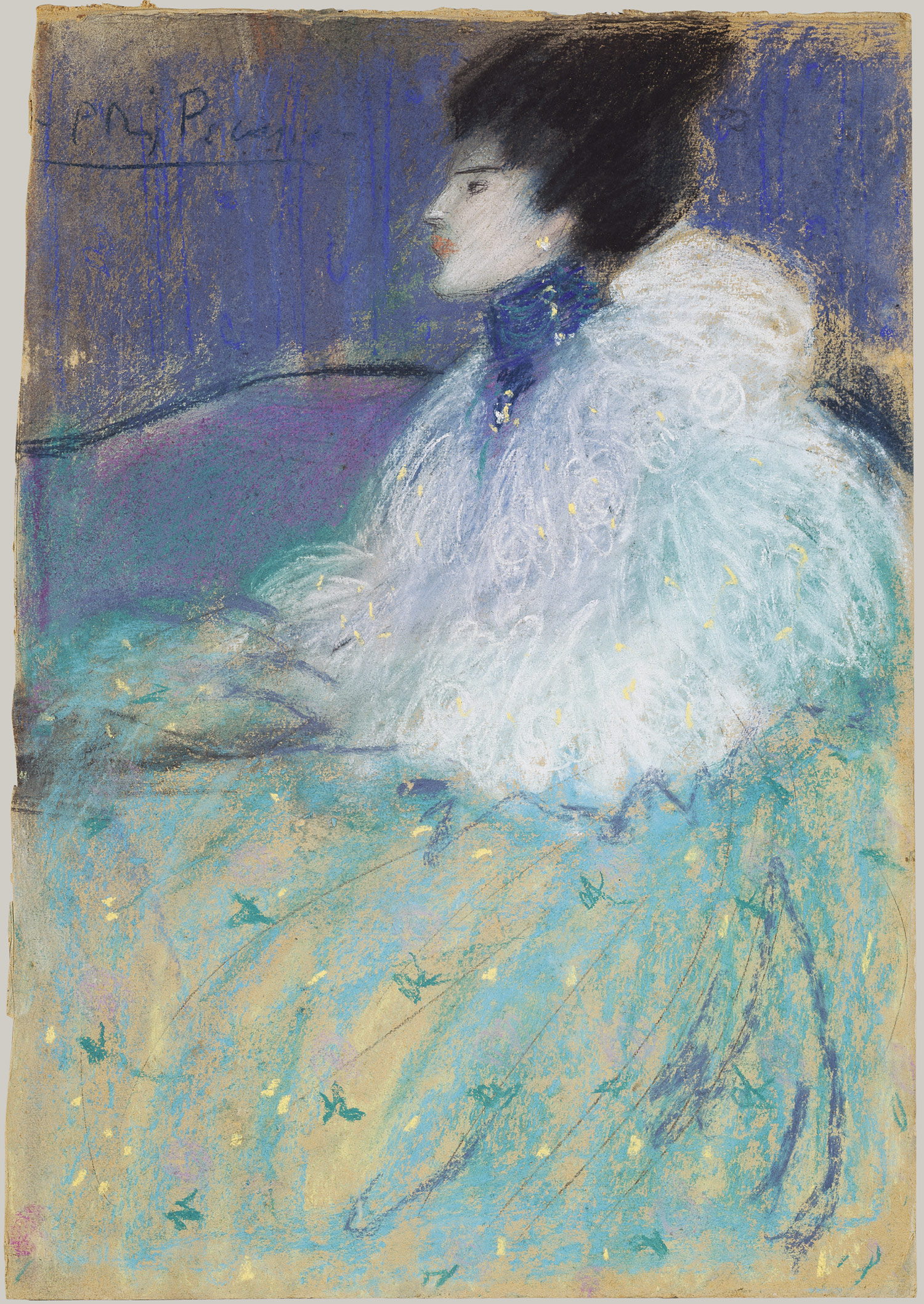
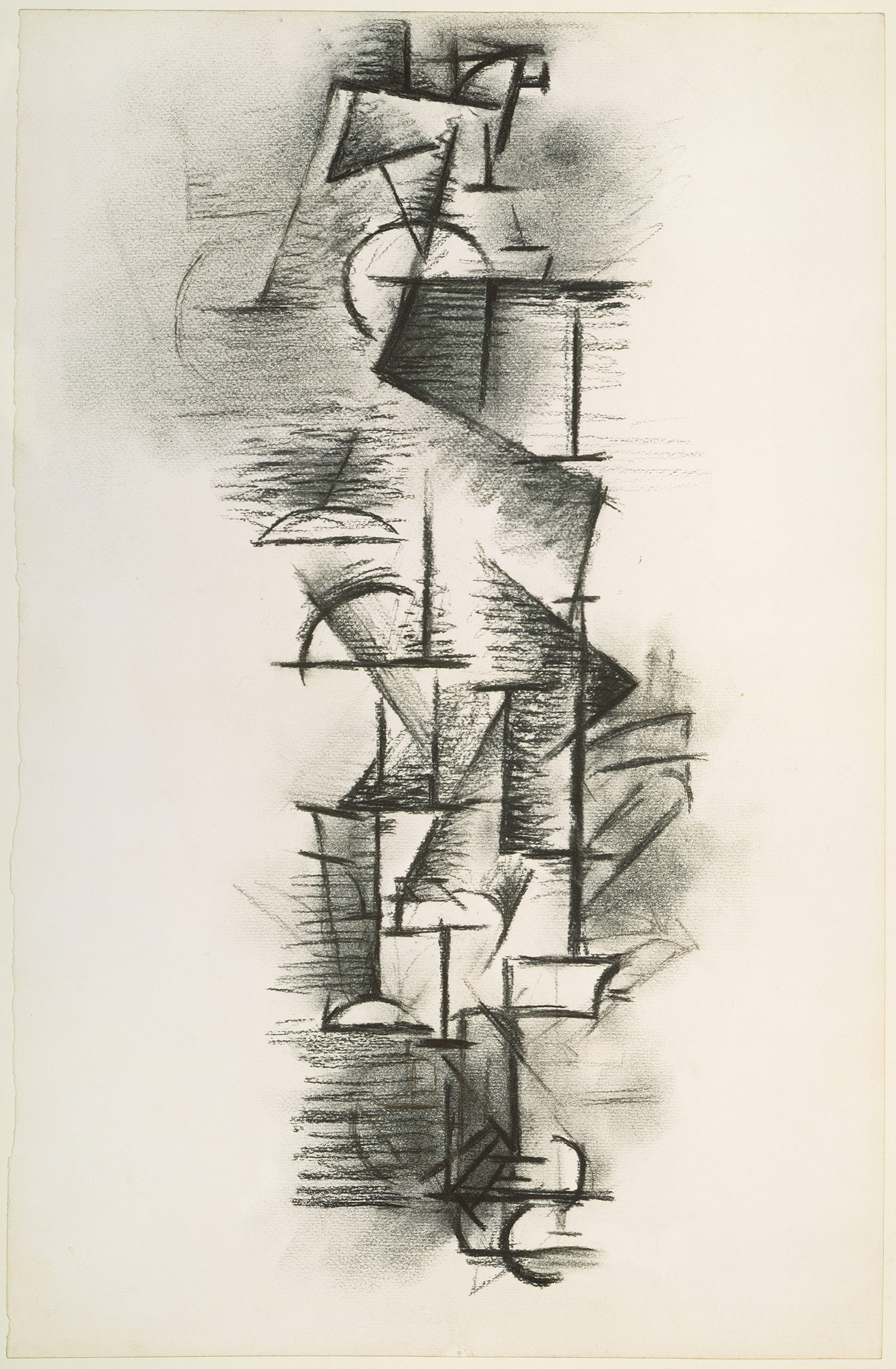
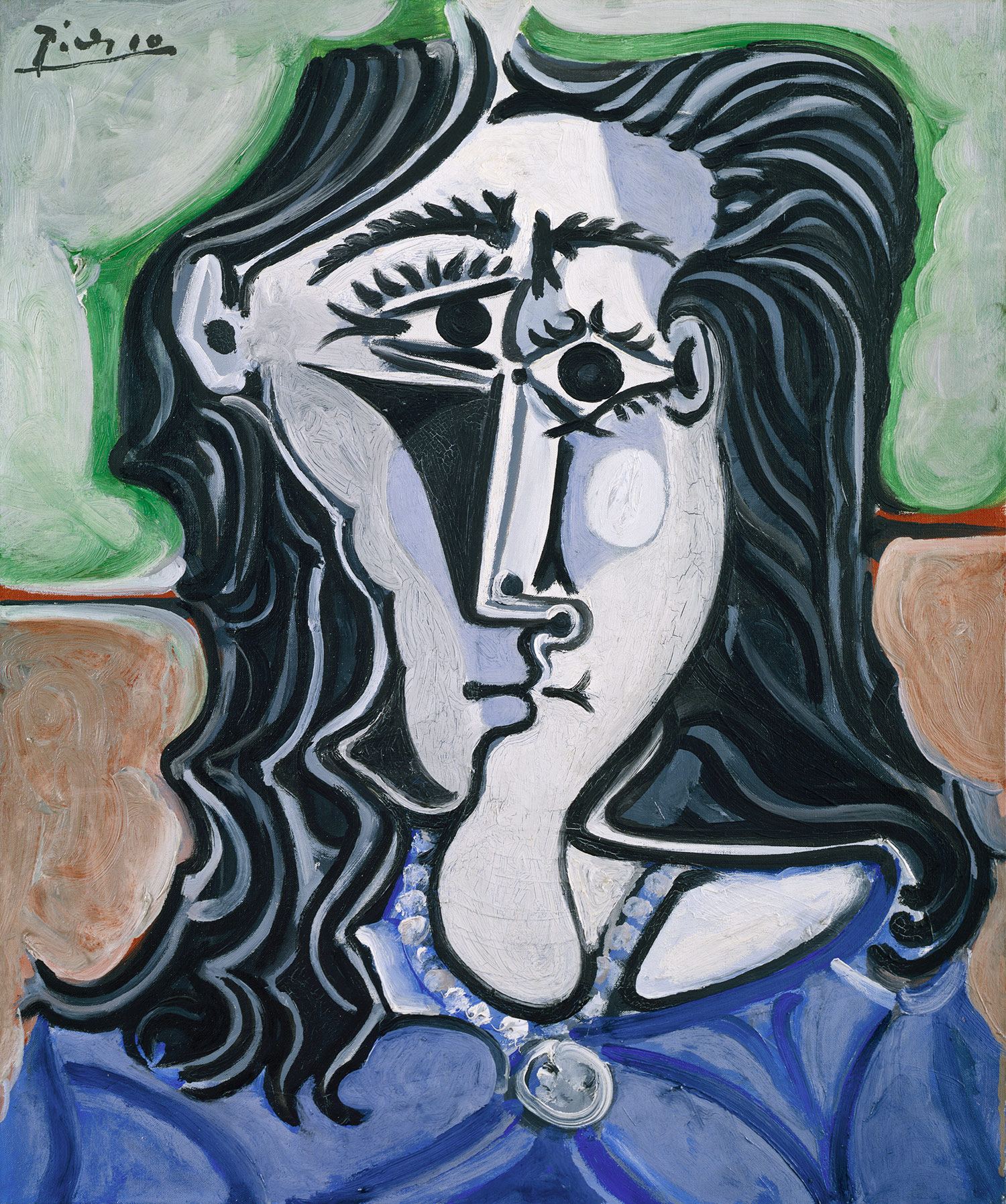
The artistic genius of Pablo Picasso (1881–1973) has impacted the development of modern and contemporary art with unparalleled magnitude. His prolific output includes over 20,000 paintings, prints, drawings, sculptures, ceramics, theater sets and costumes that convey myriad intellectual, political, social, and amorous messages. His creative styles transcend realism and abstraction, Cubism, Neoclassicism, Surrealism, and Expressionism. Born in Malaga, Spain, in 1881, Picasso studied art briefly in Madrid in 1897, then in Barcelona in 1899, where he became closely associated with a group of modernist poets, writers, and artists who gathered at the café Els Quatre Gats (The Four Cats), including the Catalan Carlos Casagemas (1880–1901).

Living intermittently in Paris and Spain until 1904, his work during these years suggests feelings of desolation and darkness inspired in part by the suicide of his friend Casagemas. Picasso's paintings from late 1901 to about the middle of 1904, referred to as his Blue Period, depict themes of poverty, loneliness, and despair. In The Blind Man's Meal (50.188) from 1903, he uses a dismal range of blues to sensitively render a lonely figure encumbered by his condition as he holds a crust of bread in one hand and awkwardly grasps for a pitcher with the other. The elongated, corkscrew bodies of El Greco (1541–1614) inspire the man's distorted features.

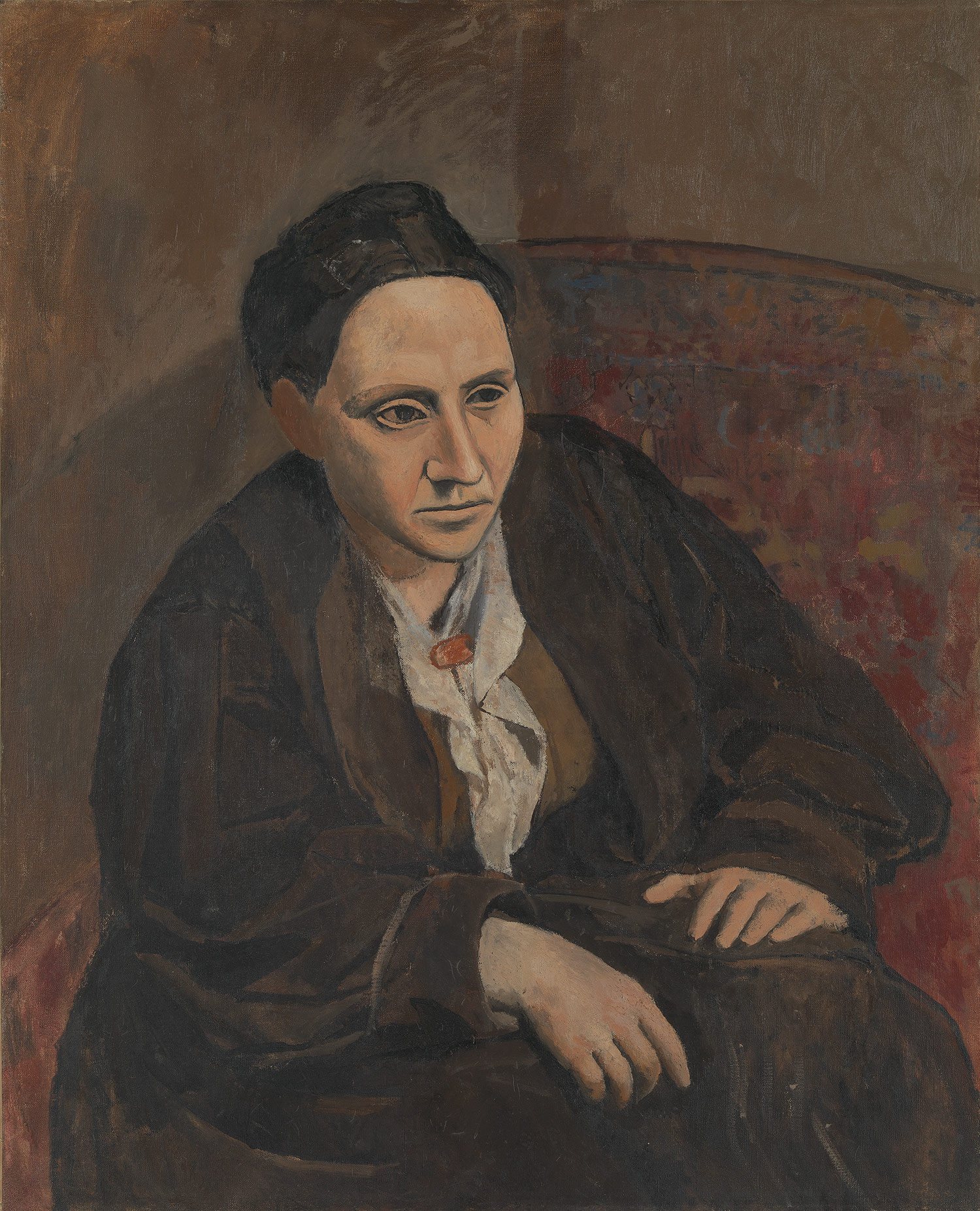
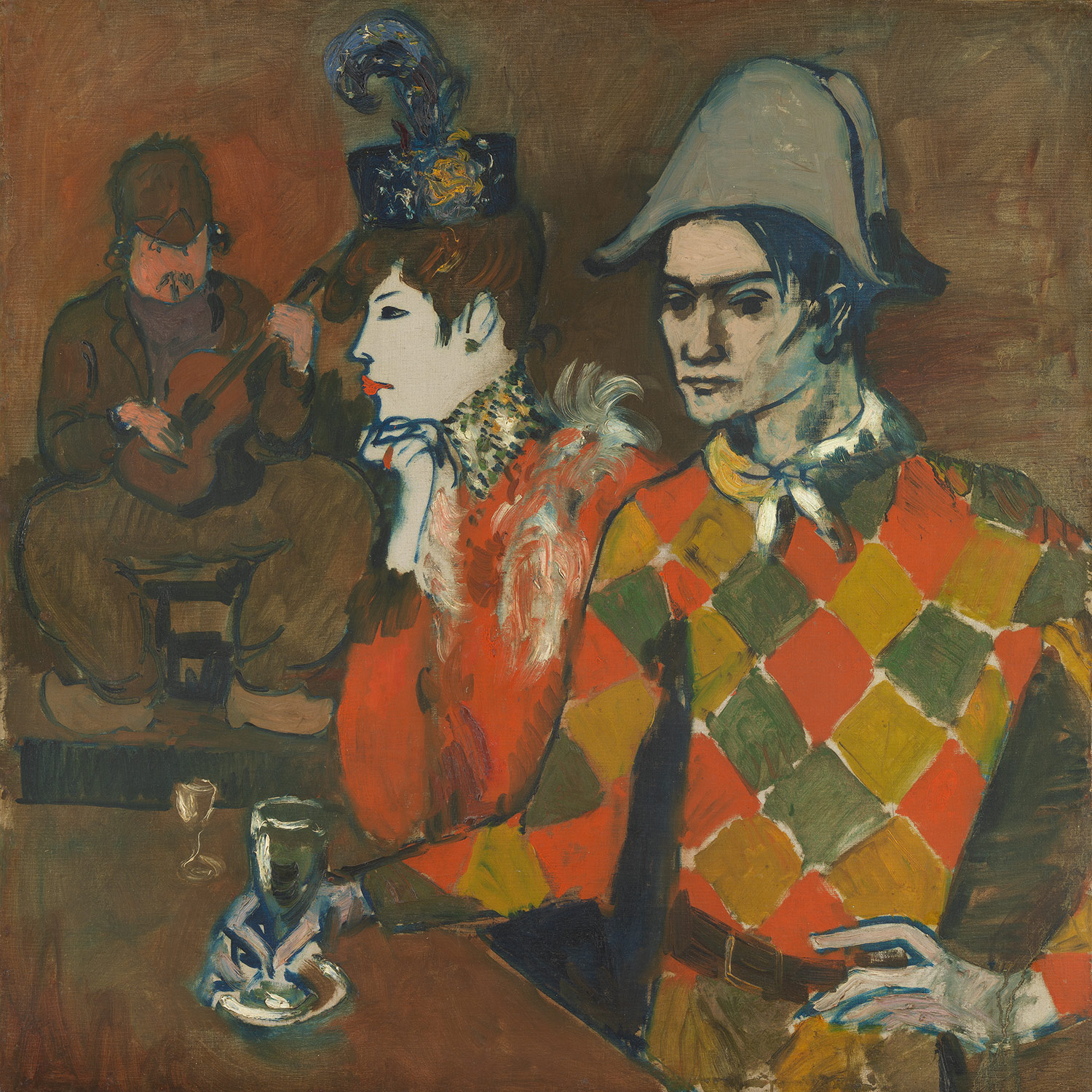
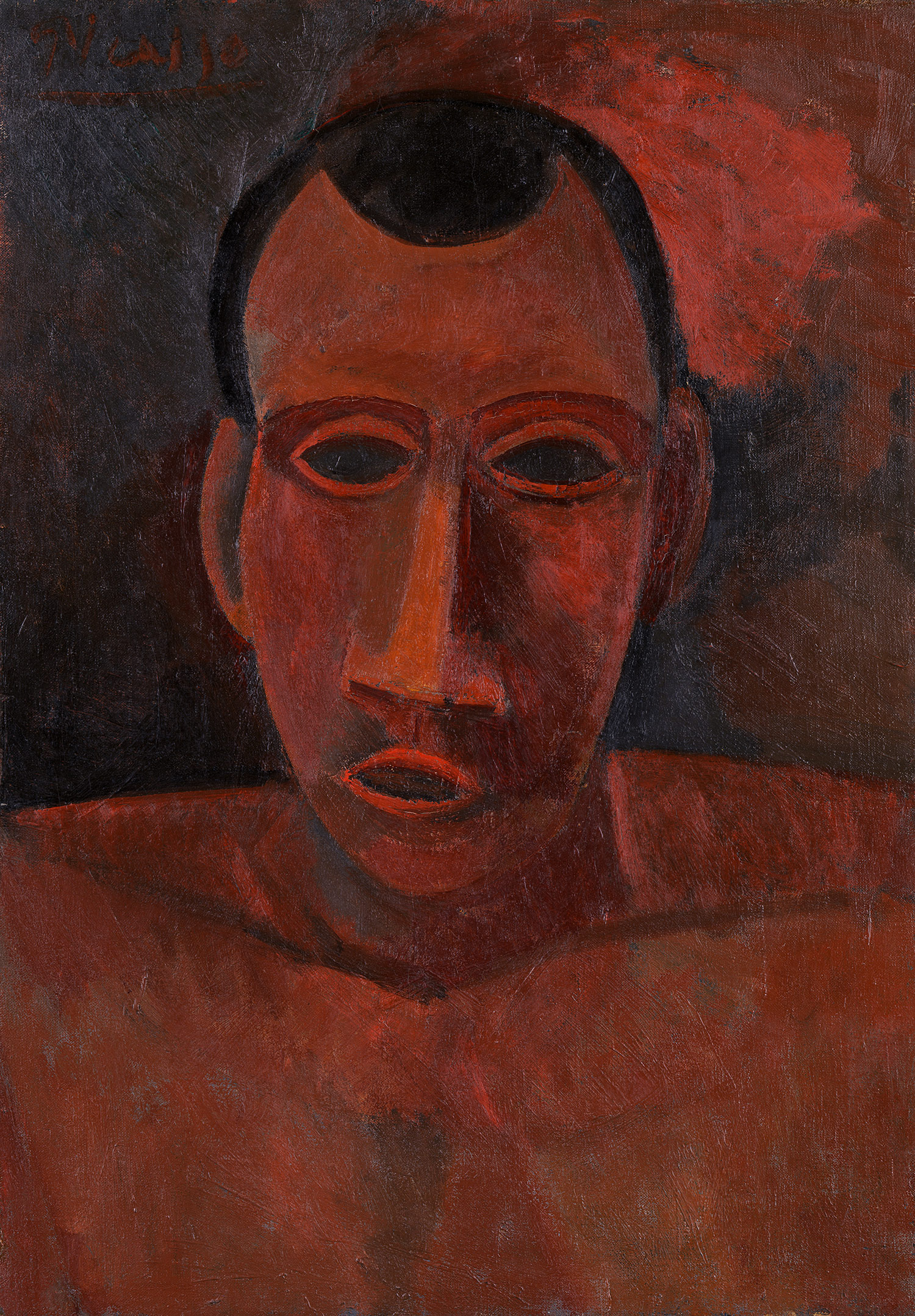
Picasso moved to Paris in 1904 and settled in the artist quarter Bateau-Lavoir, where he lived among bohemian poets and writers such as Guillaume Apollinaire (1880–1918) and Max Jacob (1876–1944). In At the Lapin Agile (1992.391) from 1905, Picasso directs his attention toward more pleasant themes such as carnival performers, harlequins, and clowns. In this painting, he uses his own image for the harlequin figure and abandons the daunting blues in favor of vivid hues, red for example, to celebrate the lives of circus performers (categorically labeled his Rose Period). In Paris, he found dedicated patrons in American siblings Gertrude (1874–1946) and Leo (1872–1947) Stein, whose Saturday evening salons in their home at 27, rue des Fleurus was an incubator for modern artistic and intellectual thought. At the Steins he met other artists living and working in the city—generally referred to as the "School of Paris"—such as Henri Matisse (1869–1954). Painted in 1906, Gertrude Stein (47.106) records Picasso's early stylistic experiments with primitivism influenced by a new fascination with pre-Roman Iberian sculpture and African and Oceanic art. Concentrating on intuition rather than strict observation, and unsatisfied with the features of Stein's face, Picasso reworked her image into a masklike manifestation stimulated by primitivism. The influence of African and Oceanic art is explicit in his masterpiece Les Demoiselles d'Avignon (1907; Museum of Modern Art, New York), a painting that signals the nascent stages of Cubism. Here the figure arrangement recalls Cézanne's compositions of bathers while stylistically it is influenced by primitivism, evident by the angular planes and well-defined contours that create an overall sculptural solidity in the figures.
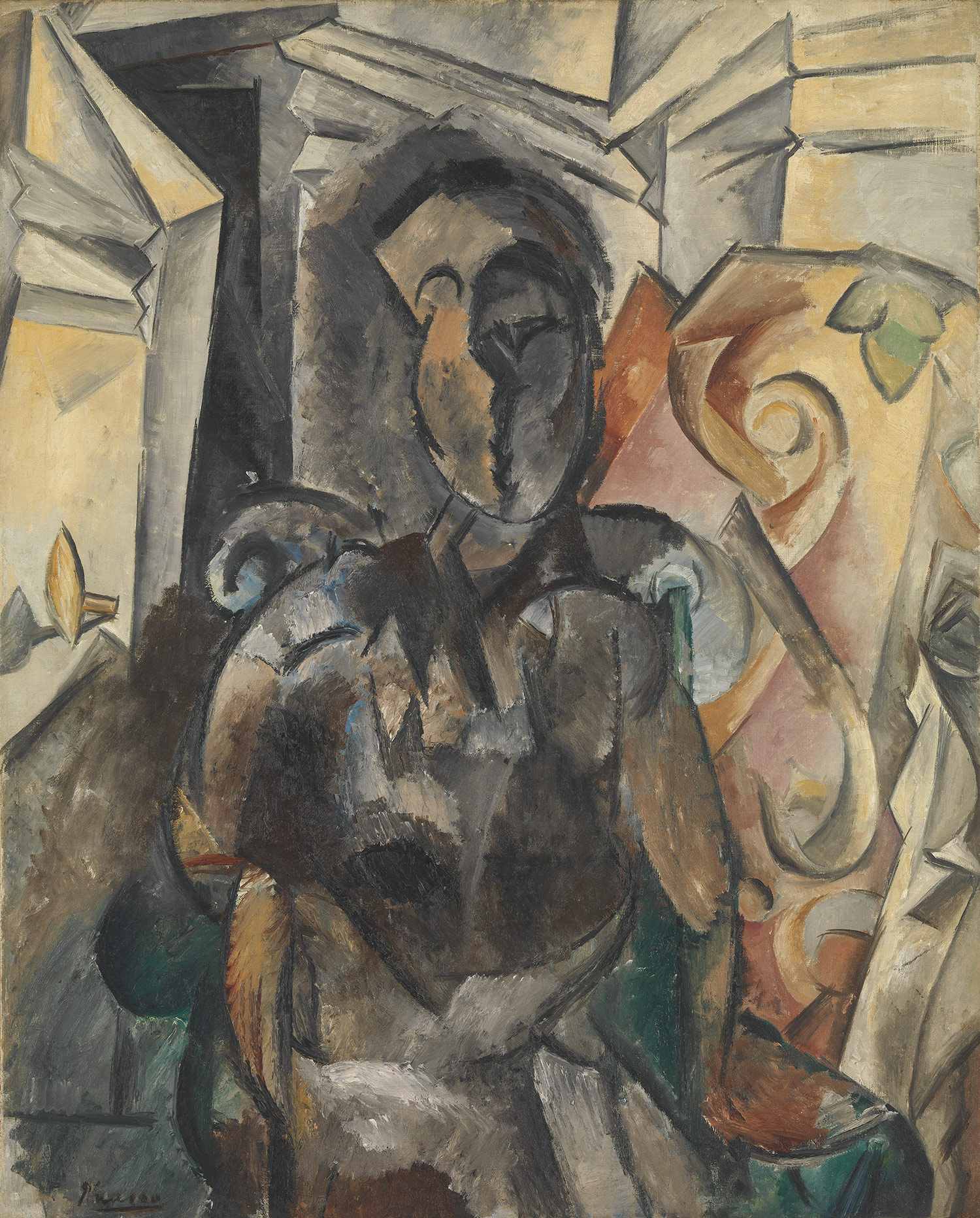
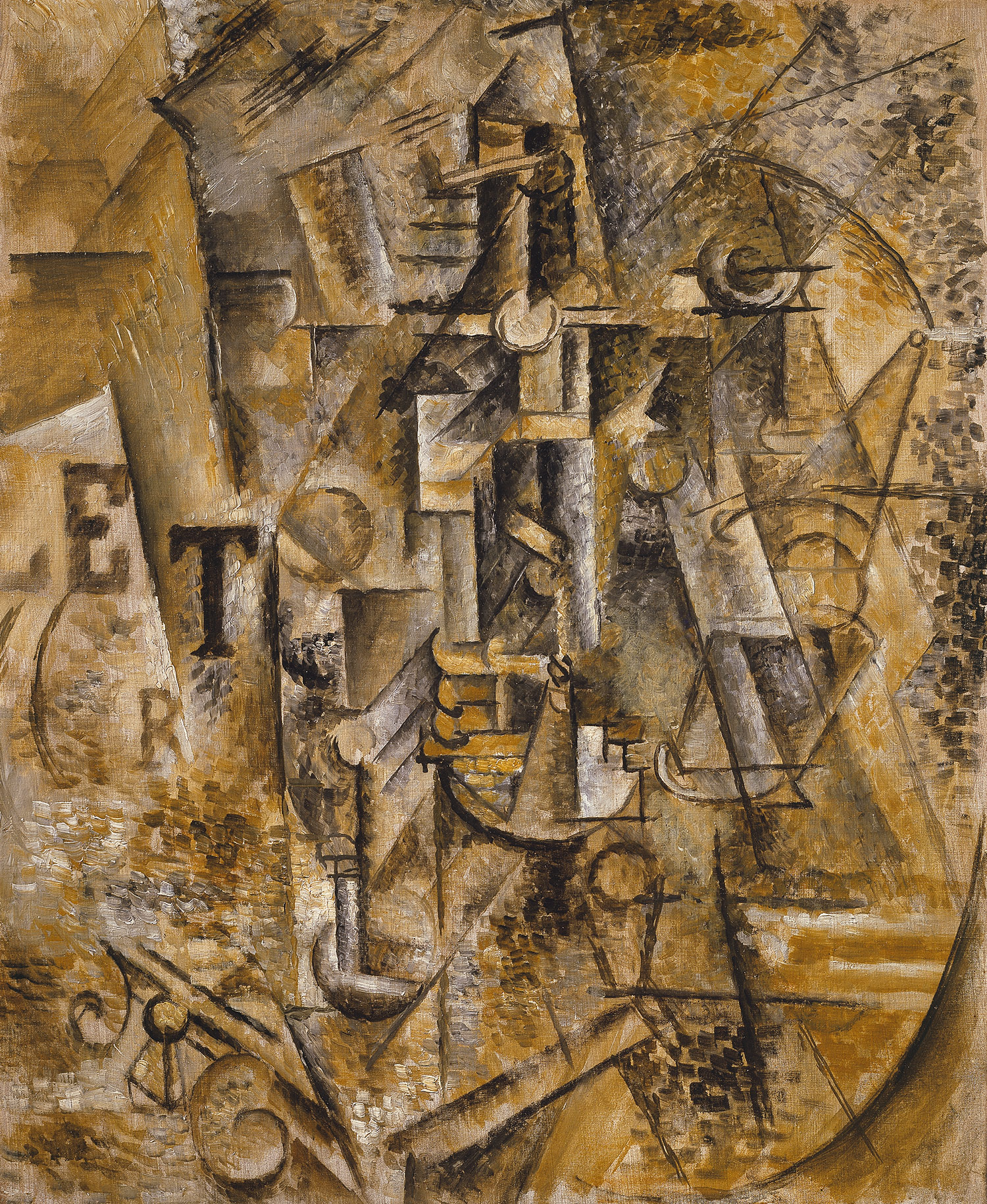
The basic principles of Analytic Cubism (1910–12), with its fragmentation of three-dimensional forms on a two-dimensional picture plane, are embodied in Still Life with a Bottle of Rum (1999.363.63), painted in 1911. The techniques of Analytic Cubism were developed by Picasso and the French artist Georges Braque (1882–1963), who met in 1907. Picasso's Bottle and Wine Glass on a Table (49.70.33) of 1912 is an early example of Synthetic Cubism (1912–13), a papier collé in which he pasted newsprint and colored paper onto canvas. Picasso and Braque also included tactile components such as cloth in their Synthetic Cubist works, and sometimes used trompe-l'oeil effects to create the illusion of real objects and textures, such as the grain of wood.

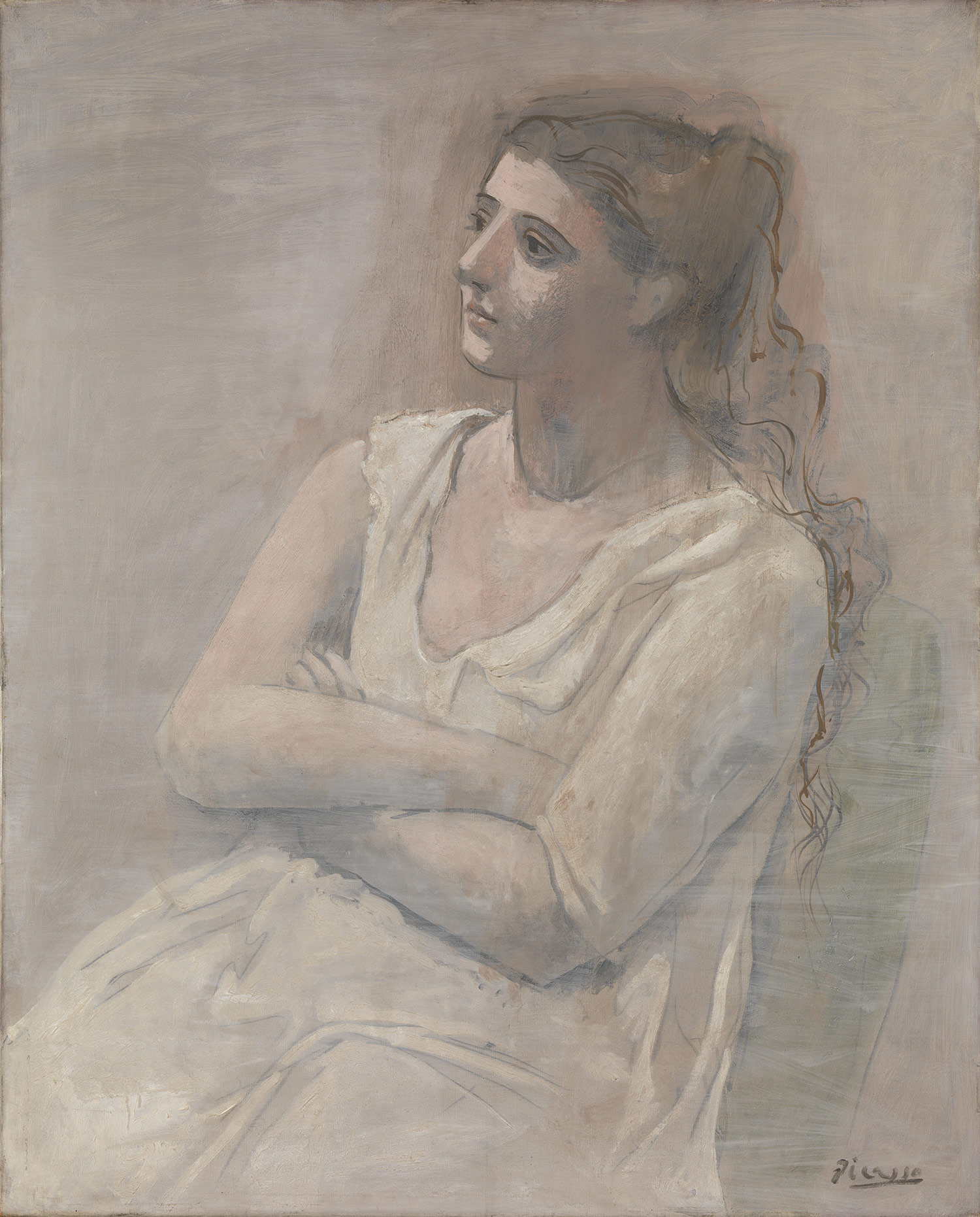
After World War I (1914–18), Picasso reverted to traditional styles, experimenting less with Cubism. In the early 1920s, he devised a unique variant of classicism using mythological images such as centaurs, minotaurs, nymphs, and fauns inspired by the classical world of Italy. Within this renewed expression, referred to as his Neoclassical Period, he created pictures dedicated to motherhood inspired by the birth of his son Paulo in 1921 (his first of four children by three women). Woman in White (53.140.4) of 1923 shows a woman clothed in a classic, toga-like, white dress resting calmly in a contemplative pose with tousled hair, eliciting a tender lyricism and calming spirit of maternity. Toward the end of the 1920s, Picasso drew on Surrealist imagery and techniques to make pictures of morphed and distorted figures. In Nude Standing by the Sea (1996.403.4) of 1929, Picasso's figure recounts the classical pose of a standing nude with her arms upraised, but her body is swollen and monstrously rearranged.
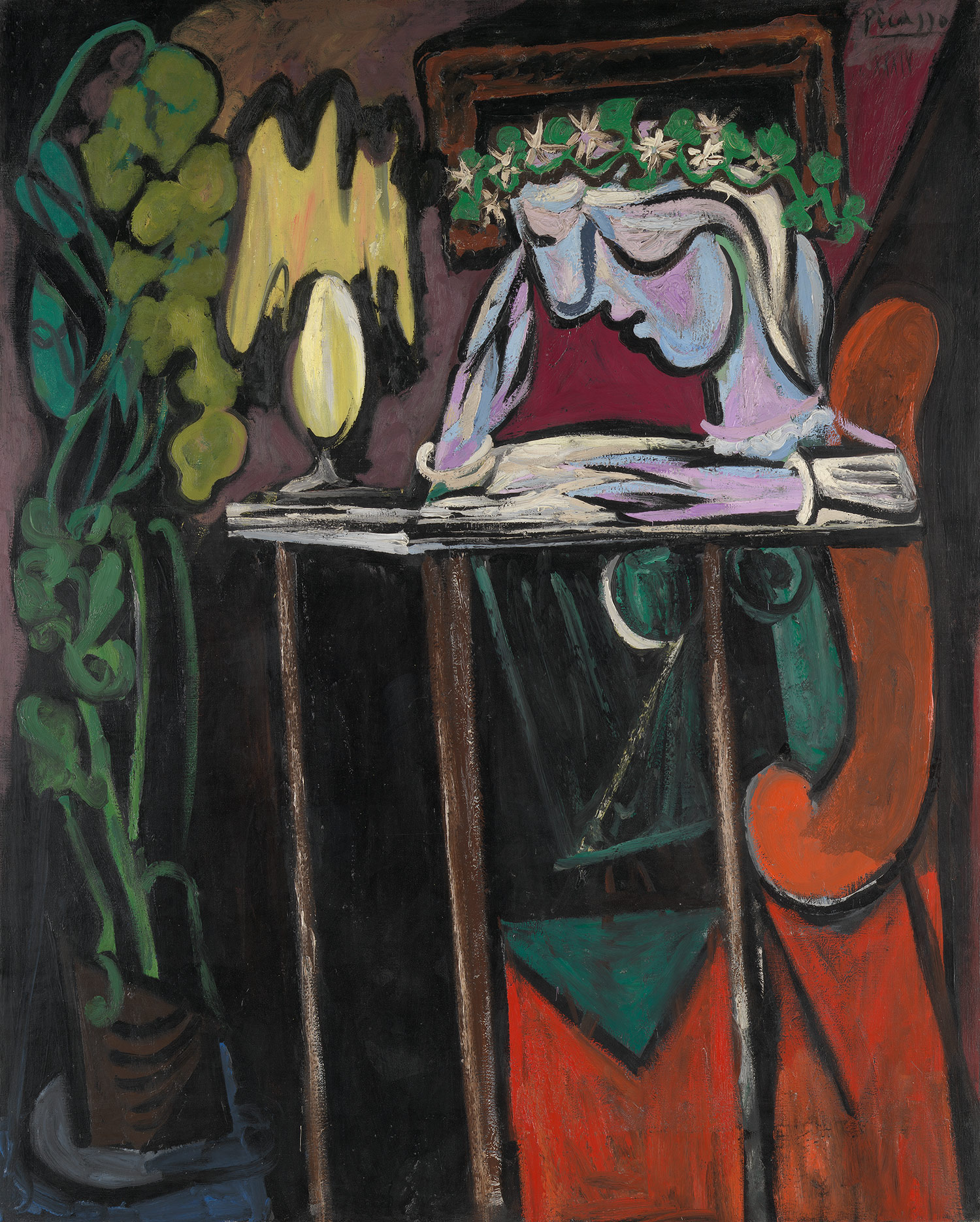
By the early 1930s, Picasso had turned to harmonious colors and sinuous contours that evoke an overall biomorphic sensuality. He painted scenes of women with drooping heads and striking voluptuousness with a renewed sense of optimism and liberty, probably inspired by his affair with a young woman (one of Picasso's numerous mistresses) named Marie-Thérèse Walter (1909–1977). Girl Reading at a Table (1996.403.1) from 1934 uses these expressive qualities of bold colors and gentle curves to portray Marie-Thérèse seated at an oversized table, emphasizing her youth and innocence.
Although still living in France in the 1930s, Picasso was deeply distraught over the outbreak of the Spanish Civil War in 1936. He reacted with a powerfully emotive series of pictures, such as The Dream and Lie of Franco (1986.1224.1[2]), that culminated in the enormous mural Guernica (1937; Reina Sofía National Museum, Madrid), painted in a grisaille palette of gray tones. This painting, Picasso's contribution to the Spanish Pavilion in the 1937 Exposition Universelle in Paris, is a complex work of horrifying proportion with layers of antiwar symbolism protesting the fascist coup led by Generalissimo Francisco Franco.
From the late 1940s through the '60s, Picasso's creative energy never waned. Living in the south of France, he continued to paint, make ceramics, and experiment with printmaking. His international fame increased with large exhibitions in London, Venice, and Paris, as well as retrospectives in Tokyo in 1951, and Lyon, Rome, Milan, and São Paulo in 1953. A retrospective in New York at the Museum of Modern Art in 1957 garnered a massive amount of attention, with over 100,000 visitors during the first month. This exhibition solidified Picasso's prominence as museums and private collectors in America, Europe, and Japan vied to acquire his works.
In Faun and Starry Night (1970.305) from 1955, Picasso returned to the mythological themes explored in early pictures. Again, incorporating life experience into his painting, he evokes his infatuation with a new love, a young woman named Jacqueline Roque (1927–1986), who became his second wife in 1961 when the artist was seventy-nine years old. In this painting, Picasso symbolizes himself as a faun, calmly and coolly gazing with mature confidence and wisdom at a nymph who blows her instrument to the stars. The picture embraces his spellbound love for Jacqueline.
Even into his eighties and nineties, Picasso produced an enormous number of works and reaped the financial benefits of his success, amassing a personal fortune and a superb collection of his own art, as well as work by other artists. He died in 1973, leaving an artistic legacy that continues to resonate today throughout the world. 

Saturday, August 25, 2012

* Culture * Books * Art and design Putting modern art on the map

Will Gompertz's tube map guide to modern art movements
Will Gompertz's tube map-style guide to modern art movements. Photograph: Viking/Penguin

The story of modern art is in many ways the story of the 20th century. Art shaped and was shaped by events, people, ideas and innovations far beyond the narrow confines of its world. The modern skyscrapers of Manhattan, TS Eliot, Monty Python, the Sex Pistols, the iPhone and the great political, philosophical and social movements of the last hundred years all owe something to the art produced by Manet, Monet and those pioneering artists who followed in their wake.
As does Harry Beck's Tube Map (1931), which I have parodied to illustrate the interconnectivity between many of the modern art movements and their main protagonists. The map is devised to give equal weight to each movement and artist, which is about as accurate as Beck's geographical representation of London: it is a necessary case of form following function. In truth, like all stories, there are lead players, support acts and a few walk-on parts. Paul Cézanne, Pablo Picasso, Kasimir Malevich and Jackson Pollock were all, of course, disproportionately influential. As were a number of those on the money side of things, including Paul Durand-Ruel (impressionism), Peggy Guggenheim (abstract expressionism) and Leo Castelli (pop art).
But there is perhaps one person above all others whose influence and personality dominate 21st-century artistic activity and critical thinking – an individual who was able to impose his will on the world without recourse to courting the media, becoming a celebrity, or having vast amounts of money. It is an incredible story within a story that starts on 2 April 1917; on this day, the American president, Woodrow Wilson, was on his feet in Washington DC urging Congress to make a formal declaration of war on Germany – a historic and world-changing moment.
Meanwhile, in New York City, three well-dressed, youngish men had emerged from a smart duplex apartment at 33 West 67th Street and were heading out into the city. They were oblivious to Wilson's exhortations, just as they were to the fact that their afternoon stroll would also have epoch-making consequences on a global scale. Art was about to change for ever.
The three friends walked and talked and smiled, occasionally breaking into restrained laughter. For the elegant Frenchman in the middle, flanked by his two stockier American companions, such excursions were always welcome. He was an artist who had not yet lived in the city for two years: long enough to know his way around, too short a time to have become blasé about its exciting, sensuous charms. The thrill of walking southwards through Central Park and down towards Columbus Circle never failed to lift his spirits; the spectacular sight of trees morphing into buildings was, to him, one of the wonders of the world.
The trio ambled down Broadway. As they approached midtown the sun disappeared behind impenetrable blocks of concrete and glass, bringing a spring chill to the air. The two Americans talked across their friend, whose hair was swept back exposing a high forehead and well-defined hairline. As they talked he thought. As they walked he stopped. He looked into the window of a store selling household goods and raised his hands, cupping his eyes to eliminate the reflection in the glass, revealing long fingers each of which was crowned with a perfectly manicured nail.
The pause was brief. He moved away from the storefront and looked up. His friends had gone. He glanced around, shrugged, lit a cigarette and crossed the road – not to find his companions, but to seek the sun's warmth. It was now 4.50pm, and a wave of anxiety washed over the Frenchman. Soon the stores would be closed and there was something he desperately needed to buy.
He walked a little faster. Someone shouted his name. He looked up. It was Walter Arensberg, the shorter of his two friends, who had supported the Frenchman's artistic endeavours in America almost from the moment he stepped off the boat on a windy June morning in 1915. Arensberg was beckoning him to cross back over the road, past Madison Square and on to Fifth Avenue. But the notary's son from Normandy had tilted his head upwards, his attention focused on an enormous concrete wedge. The Flatiron Building had captivated the French artist long before he arrived in New York, an early calling card from a city that he would go on to make his home.
His initial encounter with the high-rise building had come when it was first built and he was still living in Paris. He had seen a photograph of the 22-floor skyscraper taken by Alfred Stieglitz in 1903 and reproduced in a French magazine. Now, 14 years later, both the Flatiron and Stieglitz, an American photographer-cum-gallery owner, had become part of his new-world life.
Arensberg called again, this time with a little frustration in his voice. The other man in their party laughed. Joseph Stella was an artist too. He understood his Gallic friend's precise yet wayward mind and appreciated his helplessness when confronted by an object of interest.
United again, the three made their way south until they reached 118 Fifth Avenue, the retail premises of JL Mott Iron Works, a plumbing specialist. Inside, Arensberg and Stella chatted, while their friend ferreted around among the bathrooms and doorhandles that were on display. After a few minutes he called the store assistant over and pointed to an unexceptional, flat-backed, white porcelain urinal. A Bedfordshire, the young lad said. The Frenchman nodded, Stella raised an eyebrow, and Arensberg, with an exuberant slap on the assistant's back, said he'd buy it.
Marcel Duchamp's Fountain One of Duchamp's recreations of the original 1917 readymade, Fountain. Photograph: AFP/Getty Images
They left the store. Arensberg and Stella called a taxi while the quiet, philosophical Frenchman remained on the sidewalk holding the heavy urinal. He was amused by the plan he had hatched for this porcelain pissotière, which he intended to use as a prank to upset the stuffy American art crowd. Looking down at its shiny white surface, Marcel Duchamp (1887-1968) smiled to himself: he thought it might cause a bit of a stir.
Duchamp took the urinal back to his studio, laid it down on its back and rotated it 180 degrees. He then signed and dated it in black paint on the left-hand side of its outer rim, using the pseudonym R Mutt 1917. His work was nearly done. There was only one job remaining: he needed to give his urinal a name. He chose Fountain. What had been, just a few hours before, a nondescript, ubiquitous urinal was now, by dint of Duchamp's actions, a work of art.
At least it was in Duchamp's mind. He believed he had invented a new form of sculpture: one where an artist could select any pre-existing mass-produced object with no obvious aesthetic merit, and by freeing it from its functional purpose – in other words making it useless – and by giving it a name and changing its context, turn it into a de facto artwork. He called this new form of art a readymade: a sculpture that was already made.
His intention was to enter Fountain into the 1917 Independents Exhibition, the largest show of modern art that had ever been mounted in the US. The exhibition itself was a challenge to America's art establishment. It was organised by the Society of Independent Artists, a group of free-thinking, forward-looking intellectuals who were making a stand against what they perceived to be the National Academy of Design's conservative and stifling attitude to modern art (just as the impressionists had done in a very similar fashion over 40 years earlier).
They declared that any artist could become a member of their society for the price of $1, and that any member could enter up to two works into the 1917 Independents Exhibition as long as they paid an additional charge of $5 per artwork. Duchamp was a director of the society and a member of the exhibition's organising committee. Which, at least in part, explains why he chose a pseudonym for his mischievous entry. Then again, it was Duchamp's nature to play on words, make jokes and poke fun at the pompous art world.
The name Mutt is a play on Mott, the store from which he bought the urinal. It is also said to be a reference to the daily comic strip Mutt and Jeff, which had first been published in the San Francisco Chronicle in 1907 with just a single character, A Mutt. Mutt was entirely motivated by greed, a dim-witted spiv with a compulsion to gamble and develop ill-conceived get-rich-quick schemes. Jeff, his gullible sidekick, was an inmate of a mental asylum. Given that Duchamp probably intended Fountain to be a critique of greedy, speculative collectors, it is an interpretation that would appear plausible. As does the suggestion that the initial R stands for Richard, a French colloquialism for moneybags. With Duchamp nothing was ever simple; he was, after all, a man who preferred chess to art.
Marcel Duchamp and Bicycle Wheel Marcel Duchamp photographed in 1968 with his work Bicycle Wheel. Photograph: Hulton Getty
Duchamp had other targets in mind when selecting a urinal as a readymade sculpture. He wanted to question the very notion of what constituted a work of art as decreed by academics and critics, whom he saw as the self-elected and largely unqualified arbiters of taste. His position was that if an artist said something was a work of art, having influenced its context and meaning, then it was a work of art, or at least demanded to be judged as such. He realised that although this was a fairly simple proposition to grasp, it would revolutionise art if accepted.
Until this point, the medium – canvas, marble, wood or stone – had dictated to an artist how he or she could go about making a work of art. The medium always came first, and only then would the artist be allowed to project his or her ideas on to it via painting, sculpting or drawing. Duchamp wanted to flip the hierarchy. He considered the medium to be secondary: first and foremost was the idea. Art could be constructed from, and mediated through, anything. That was a big idea.
The hidden meanings contained within Fountain don't end in Duchamp's wordplay and provocation. He specifically chose a urinal because as an object it has plenty to say, much of it erotic, an aspect of life that Duchamp frequently explored in his work. It doesn't, for example, take much imagination to see its sexual connotations when presented upside down. That allusion may or may not have been understood by those who sat alongside Duchamp on the organising committee; either way his co-directors were unimpressed. Fountain was rejected and banned from the 1917 Independents Exhibition. The feeling among the majority of the society's directorate (there were some, including Arensberg and Duchamp, who argued passionately in its favour) was that Mr Mutt was taking the piss.
Which of course he was. Duchamp was challenging his fellow society directors and the organisation's constitution, which he had helped to write. He was daring them to realise the idea that they had collectively set out, which was to take on the art establishment and the authoritarian voice of the conservative National Academy of Design with a new liberal, progressive set of principles. The conservatives won the battle, but as we now know, spectacularly lost the war. R Mutt's exhibit was deemed too offensive and vulgar on the grounds that it was a urinal, a subject that was not considered a suitable topic for discussion among America's puritan middle classes. Team Duchamp immediately resigned from the board. Fountain was never seen in public, or ever again. Nobody knows what happened to the Frenchman's pseudonymous work. It has been suggested that it was smashed by one of the disgusted committee, thus solving the problem of whether to show it or not. Then again, a couple of days later, at his 291 gallery, Stieglitz took a photograph of the notorious object, but that might have been a hastily remade version of the readymade. That too has disappeared.
But the great power of ideas is that you cannot uninvent them. The Stieglitz photograph was crucial. Having Fountain photographed by one of the art world's most respected practitioners, who also happened to run an influential gallery in Manhattan, was important. It was an endorsement of the work by the avant garde, and provided a photographic record: documentary proof of the object's existence. No matter how many times the naysayers smashed Duchamp's work, he could go back down to JL Mott's, buy a new one and simply copy the layout of the R Mutt signature from Stieglitz's image. And that's exactly what happened. There are 15 Duchamp-endorsed copies of Fountain to be found in collections around the world.
When one of those copies is put on display it is weird to see people taking it so seriously. You see hordes of earnest exhibition visitors craning their heads around the object, staring at it for ages, standing back, looking at it from all angles. It's a urinal! It's not even the original. The art is in the idea, not the object.
The reverence with which Fountain is now treated would have amused Duchamp, who chose it specifically for its lack of aesthetic appeal (something he called anti-retinal). The original readymade sculpture was really only ever intended as a provocative prank, but has gone on to become perhaps the single most influential artwork of the 20th century. The ideas it embodied directly influenced several major art movements, including dada, surrealism, abstract expressionism, pop art and conceptualism. Duchamp is unquestionably the most revered and referenced artist among today's contemporary artists, from Jeff Koons to Ai Weiwei.
Ai Weiwei's Forever Ai Weiwei's Forever. Photograph: Ren Zhenglai/XinHua/Xinhua Press/Corbis
In fact the Chinese artist and activist has modelled his entire output and approach to life on Duchamp's example. He, like the Frenchman, is at the centre of his own universe: fearless and determined, an artist whose own readymades are also often superficially playful but contain profound questions and statements. He too makes assisted readymades, which in Ai Weiwei's case often begin with 4,000-year-old neolithic Chinese pottery vases, ancient and revered objects which he then decorates in gaudy modern colours, or sometimes with the Coca-Cola logo.
On one occasion he thought it would be amusing to take a series of photographs of himself dropping one of these vases on to a concrete floor – to record the moment when it smashed. He duly did this and thought nothing more of it until an exhibition of his work was being assembled at an art gallery. The curator contacted him to say that they didn't have quite enough for the show and to ask if he had anything else. The artist had a rummage in his studio and came up with the photographs of the dropping of the vase. The images were then hung in the gallery under the title Dropping a Han Dynasty Urn (1995) and duly became a famous artwork. Which proved Ai Weiwei correct in his belief that his every action is part of his art, while also echoing an example of Duchamp retro-fitting, when he proclaimed that his bicycle wheel attached to the top of a stool was an assisted readymade, even though at the time he made it only as an amusement for himself.
It is Duchamp who is to blame for the whole "is it art?" debate – which was, of course, what he intended. It is because of Duchamp that Tracey Emin's unmade bed (My Bed, 1998) is a work of art and yours is not. But that is not to say that Emin's or any other artist's conceptually based work is necessarily worthy of our attention – each piece should be judged on its merits, as the American artist Sol LeWitt pointed out.
He wrote in an essay in 1967 that conceptual art is only good if the idea is good. And that you can decide for yourself.

Art, inspiration and an empty canvas

Western star ... the ubiquitous ute, favoured transport in Broken 
Hill. Western star ... the ubiquitous ute, favoured transport in Broken Hill. Elissa Blake takes an art-lover's tour of Broken Hill, with larger-than-life characters and even larger landscapes.
Rusted iron. Rich olive. Cappuccino. Dirty gold. An array of warm purples and greys. The colours emerging from the rocky outcrops just outside Broken Hill have been inspiring painters for decades. Asthe sky turns rosy pink in the Living Desert Reserve, over 12 massive sculptures carved from 52 tonnes of Wilcannia sandstone, I can see why this semi-arid city on the edge of the outback is a magnet for painters and art lovers.
Many of those artists, some of them former miners or their descendants, were inspired to pick up paintbrushes by the example of Pro Hart, the ebullient miner-turned-art celebrity whose irreverent images of gamblers, drunks and local characters are famous around the world. Like Hart, who died in 2006, most of these artists are self-taught and welcome visitors to their own galleries - often the front room of their homes.
The Broken Earth complex. The Broken Earth complex. The locals say there is a sense of "spirit" in this country. In the silence, the vastness of the landscape and the sky certainly put you in your place. "I see the landscape as almost prehistoric," Ian Howarth says as he scans the 360-degree view of the scrubby plains bordered in the distance by the Barrier and Flinders ranges. "It's so weathered and worn. It carries the weight of aeons of time. It's almost the land that time forgot."
Howarth is the gallery assistant at the Regional Art Gallery, established in 1904. He is driving me about town in his ute. Every second car is a four-wheel-drive in Broken Hill, he says, laughing. "The rest are utes. No one walks anywhere. It's either too hot, too cold or too windy."
The main street is incredibly quiet and pedestrians are few - maybe everyone is in their car. But those residents I do meet are lively, generous with their time and quick to laugh. About 18,000 people live here, an ageing population with pockets of young families and transient workers. Everyone I meet feels a deep connection to the history of the city.
The Mineral Art and Mining Museum.
The Mineral Art and Mining Museum. "It used to be a pretty rough town with boxing and wrestling every Saturday night," says artist Jack Absalom, 84, one of the grandfathers of the art scene. "All disputes were settled on a Sunday morning with fisticuffs. Now it's all calmed down." He remains as feist as ever, telling me Sydney would be nothing but a fishing village without the wealth extracted from the mines in Broken Hill. "Sydney people are parasites on the community."
Absalom's gallery is a headline attraction on the Broken Hill art tourist trail. He is the only surviving member of the Brushmen of the Bush still resident in the town. The five Brushmen - Hart, Absalom, Hugh Schultz, Eric Minchin and John Pickup - painted landscapes in the Broken Hill area and gained fame in the art world in the 1970s, exhibiting across Australian and in London, Rome, New York and Los Angeles.The only other surviving member is Pickup, who now lives in Queensland. Absalom shows me an impressive range of minerals and opals in his gallery and tells me how he chose to paint on "huge canvases" to capture the isolation and the dry, brick-red beauty of the earth.
"Of course, now it's all bloody green," he says. "We've had the first big rains since 1973 and the whole place is green."
Green isn't the word I would have chosen to describe the vegetation masking the famous red dirt. But it's certainly on everyone's mind. In August last year, the city lost its chance to feature in George Miller's Mad Max: Fury Road, the fourth instalment in the Mad Max series. Despite years of preparation for the shoot, the landscape was deemed insufficiently post-apocalyptic after heavy rain resulted in wildflowers blooming in the desert. The Namibian desert was chosen for the shoot instead.
It was a heavy blow to an area whose film-production CV includes Mad Max 2, Wake in Fright, Razorback, A Town Like Alice, DirtyDeeds and Priscilla, Queen of the Desert. Broken Hill's cavernous central power station, built in 1931 and operated until 1986, has been converted into a film studio - the city is trying to attract more productions.
I head over to Pro Hart's gallery, the most popular art attraction in Broken Hill, to meet his widow, 73-year-old Raylee Hart, and his son, John, also a painter. She tells me Hart put Broken Hill on the map and opened visitor's eyes to the history of the mines, which dates to the discovery of silver ore in 1883.
"There is a lot of living history here," she says. "The mines are still here and the little miners' cottages made out of corrugatediron are all still here. Everyone is restoring their awnings and verandahs in heritage colours. It's not just an artist's paradise; there is so much history here that we're proud of."
Charles Sturt was the first European explorer to pass within sight of the "broken hill" in 1844, a rocky ridge jutting above the plains, an outcrop of what was then the richest deposit of lead, silver and zinc in the world. But it would be another 40 years before boundary rider Charles Rasp pegged the first mineral lease in the area, attracting thousands of miners from the declining copper towns in South Australia, as well as the Victorian goldfields.
Broken Hill, often called the Silver City, has enjoyed (and endured) 127 years of continuous mining activity. Its people have witnessed the birth of the trade union movement, several momentous strikes (one in 1919 lasted 18 months) and many booms and busts.
Rae Dellar tells me all about it. She is 66 and works at the Broken Hill Visitor Information Centre, and there isn't much she doesn't know about the town and its people. During a two-hour walking tour of the town with Dellar, I learn about the history of the mines and the railway line, the town's myriad architectural styles and its pride in the union movement. She points out the rambling Sturt's desert peas in bloom by the railway station and the crystals and minerals in the city's three mineral museums. Most of the streets in town are named after minerals or chemical compounds: Crystal, Mercury, Bromide, Sulphide, Oxide.
The most remarkable feature of town is the enormous Line of Lode (affectionately known as the slag heap), a mountain of residue from silver-ore smelting that divides the town through its centre. At its top sits a cafe-restaurant, the Broken Earth, with panoramic views. From here you can see that Broken Hill is an oasis, a thriving metropolis in the middle of seemingly endless flat terrain sprinkled with saltbushes and mulga trees.
Just outside is a stark memorial to the workers who died in the city's mines since the late 19th century - more than 700 people. Each miner is listed with his name, age and cause of death: asphyxiation from dynamite fumes, premature explosion, dust on the lungs, lead poisoning, rockfalls. Underground safety improved over time but deaths were not uncommon. One miner is listed as being crushed by an ore truck. Another died by being caught in belting. One man was killed in a remote-controlled loader accident. It is a stark reminder that mineral wealth does not come cheap. The youngest miner is listed as only 12 years old. "He might have been younger," Dellar says. "Boys often lied about their age."
She knows all the town's plaques and memorials. There's one to remember opera star June Bronhill, the local girl who changed her name from Gough to Bronhill (a contraction of Broken Hill) in gratitude to those who raised money to send her to London to train. Another pays respect to Vivian Bullwinkel, a sister at the Broken Hill hospital and the only survivor of the Banka Island massacre, in which 21 Australian nurses were shot by Japanese soldiers in 1942.
We finish our tour at the Palace Hotel, where scenes fromPriscilla, Queen of the Desert were filmed. A family is on the verandah playing a board game. Inside, the bar is a mix of period furniture and low lights. More than a pub, the Palace is a living museum that pays tribute to Broken Hill's history, characters and the city's future as an oasis of artistic endeavour.
Opposite the hotel is Broken Hill's World War I memorial, where a statue of an Australian soldier in battle-worn uniform is about to hurl a Mills bomb. Dellar smiles. "There's a saying that in a mining town, never blow up a hotel."